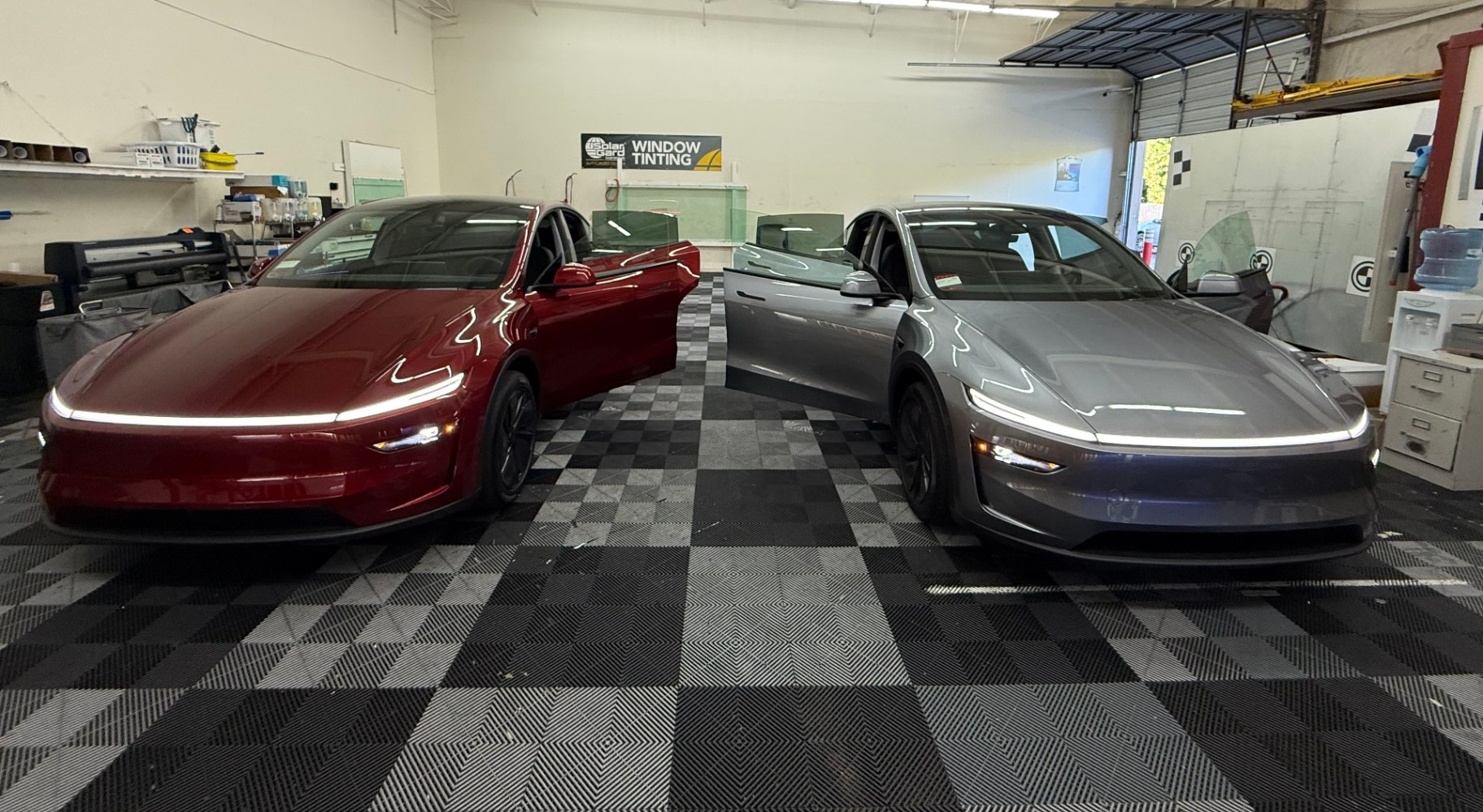
The Model Y is one of the most common vehicles in our tint bay, and the question is almost always the same: which percentage should I choose? The honest answer depends on three things — California law, how much heat you want rejected, and how the car already came from the factory.
Start with what Tesla already installed
Model Y rear side windows and rear glass come tinted from the factory. Adding film there mainly changes appearance and adds heat rejection; it will not look like a dramatic change. The front side windows are clear from the factory, and that is where most owners notice the biggest difference in comfort.
The glass roof has a factory coating that blocks a large share of ultraviolet and some infrared energy, but on a hot Tri-Valley afternoon many owners still want more. Roof film is a common add-on.
California limits, in plain terms
California allows film on the front side windows only if the combined light transmission of the film and glass is at least 70 percent. In practice that means a very light, high-performance film on the fronts — not a 35 or 20 percent look.
Rear side windows and the rear window may be darker, as long as the vehicle has both side mirrors. On the windshield, film is limited to the area above the AS-1 line.
Enforcement is real in California, so we will not install a front-window shade that does not comply.
What we usually recommend on a Model Y
- Front side windows: a ceramic film in the high-transmission range so the combined glazing stays at roughly 70 percent. You gain heat and UV rejection without a visible dark look.
- Rear sides and rear glass: many owners choose 20 to 35 percent over the factory tint for a uniform, finished appearance and additional heat rejection.
- Glass roof: a ceramic film chosen for infrared rejection rather than darkness. This is the single change most Model Y owners tell us they feel.
- Windshield: a clear or near-clear ceramic film, or film above the AS-1 line only.
Why ceramic rather than dyed film
Darkness and heat rejection are not the same thing. A dark dyed film can still let a lot of infrared energy through, while a light ceramic film can reject much more. Because California restricts how dark your front windows can be, film quality — not shade — is what determines whether the cabin actually feels cooler.
Ceramic films are also non-metallic, so they do not interfere with the Model Y's cellular, GPS, or key-card reception.
Cabin overheat protection and range
Tesla's cabin overheat protection and air conditioning both use energy. Reducing how much heat enters the cabin means those systems run less in hot weather. Owners often report a more comfortable start and less time waiting for the cabin to cool. Treat any specific range figure you read online with caution — the comfort benefit is the reliable one.
Compare films before you decide
We install both 3M Crystalline and Xenith ceramic film, and the performance data for each shade is published on our site so you can compare rather than guess. See 3M Crystalline, Xenith ceramic, or our Tesla window tinting page.
Bring your Model Y to our Dublin shop and we will show you sample panels on your own glass before anything is installed. Call 925-492-7272 to schedule.